
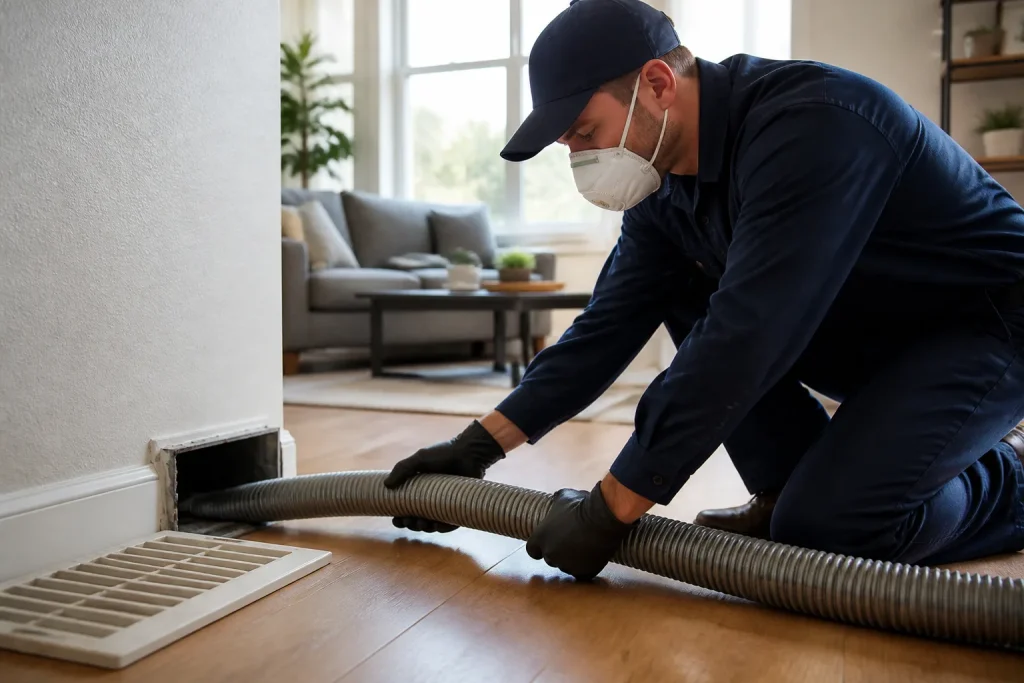
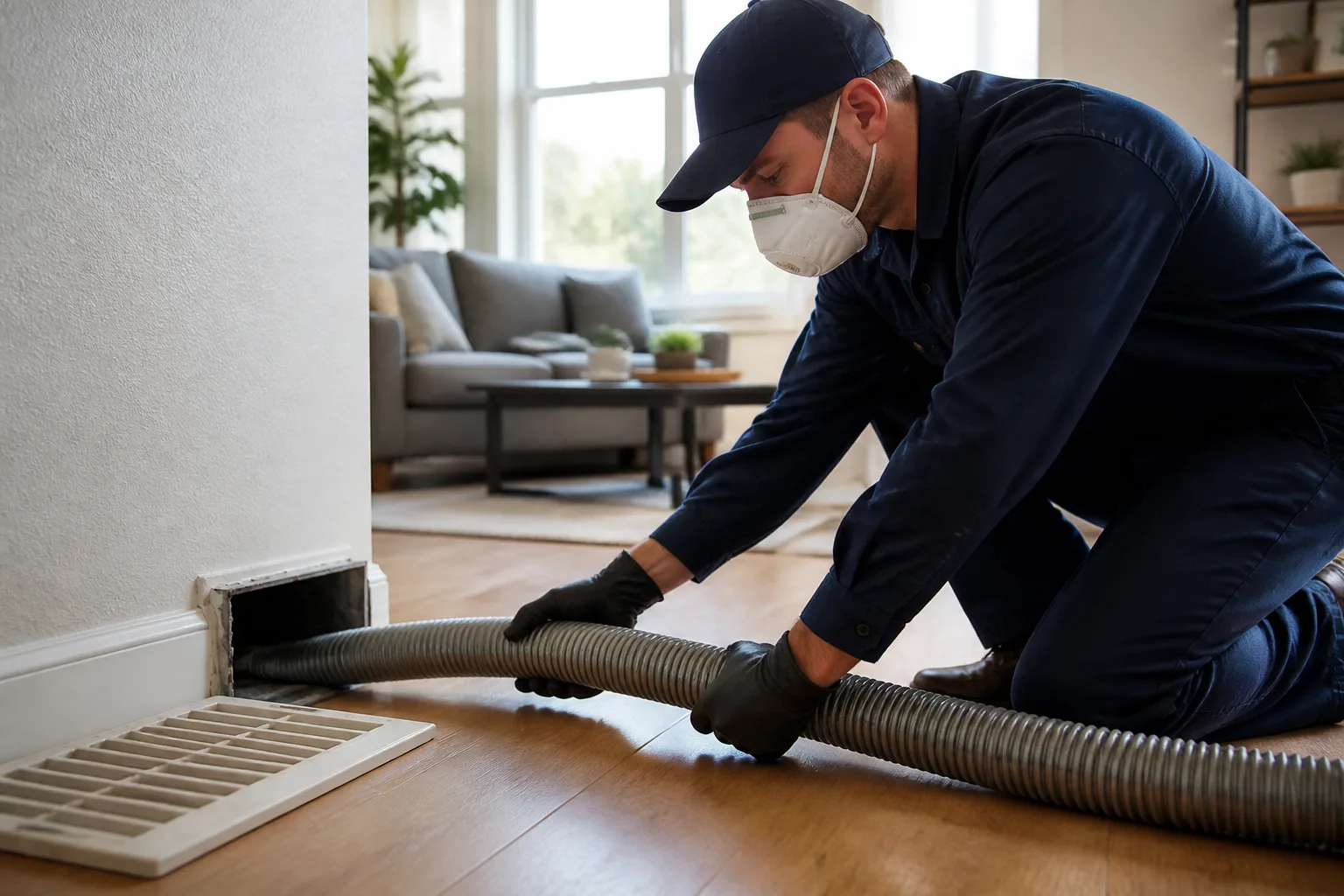
Emergency Air Duct Cleaning Near Me: What Lakewood Homeowners Should Do First
The most common mistake we hear about after a sewage backup or an attic rodent discovery in Lakewood is this: the homeowner walks to the thermostat and turns the system back on to “clear the air.” That single action pushes contamination through every supply run in the house before anyone arrives to help. If your ducts have taken on sewage, smoke, or animal waste, the correct first move is usually to shut the system down and seal what you can. Here’s how to tell a real emergency from a job that can wait for a scheduled visit, and what to do in the first thirty minutes.
If you’d rather not work through this alone, call (844) 914-0778. We answer 24/7. Fast dispatch from 7am to 7pm, Sunday through Friday.
Key Takeaways
- Turn the HVAC system off first. Running it spreads contamination to every room.
- Only three situations are true duct emergencies: sewage infiltration, post-fire smoke contamination, and rodent or pest intrusion.
- Temporary sealing of supply registers buys time; it does not solve the problem.
- Most emergencies come with repair needs, which is why we clean it and, if it’s broken, we fix it.
- Wildfire smoke is a semi-emergency with a real window before odor sets into duct liner.
What Counts as a Real Duct Emergency in Lakewood?
A genuine duct emergency is one where contamination is actively moving through your system or will be the moment air starts flowing again. Three scenarios meet that bar in Lakewood homes: sewage backup that has reached ductwork or a crawlspace connected to it, smoke and soot pulled into the system after a house fire, and rodent or pest intrusion with droppings inside the runs. Everything else, including heavy dust, musty odors, and a recent HVAC install, is a scheduled-appointment situation.
Why the distinction matters: a real emergency needs a technician equipped for contamination-level work, not a routine dust removal booking. Our Abatement Technologies equipment exists for exactly these jobs, and it’s part of the reason we ask detailed questions when you call. Standard cleaning companies show up with a vacuum and a quote. That’s fine for maintenance. It’s the wrong tool for a sewage event.
Situations that feel urgent but can wait for a normal appointment:
- A dusty smell the first time the heat kicks on in fall
- Allergy flare-ups that seem worse indoors than out
- A dryer that takes two cycles to dry a load (worth scheduling soon, but not an emergency call)
- Visible dust around a register after a renovation
If you’re in the middle of one of those, a standard air duct cleaning visit handles it. If you’re not sure which category you’re in, describe what happened and we’ll tell you honestly.
Step-by-Step: What to Do in the First 30 Minutes
The single most useful thing you can do before a technician arrives is stop the system from moving air. Here is the sequence for each emergency type. These are containment steps, not a DIY repair; the actual work needs professional equipment and, in most cases, trained hands.
If sewage has backed up into your ducts or crawlspace
- 1
Shut the HVAC system off at the thermostat. Do not run it to “dry things out.”
- 2
Turn off the water supply to the affected fixtures if the source is still active.
- 3
Seal supply registers in rooms nearest the contamination with plastic sheeting and tape to slow cross-migration.
- 4
Keep people and pets out of affected rooms. Sewage carries real health risks, and this is not a shop-vac job.
- 5
Call for professional help and describe exactly where the backup reached.
If a fire has occurred
- Do not run the system, even briefly, to test it. Soot and smoke residue redistribute fast.
- Keep windows closed once the fire is out; outside air can pull residue deeper into porous duct liner.
- Seal registers nearest the fire area.
- Note which rooms had visible smoke damage so you can tell the dispatcher.
If you’ve found rodent activity
- Shut the system off immediately. Droppings and nesting material inside ducts become airborne the second the blower runs.
- Don’t vacuum with a household machine; it will exhaust fine particulates back into the room.
- Photograph what you found, then seal registers in the affected area.
- Call a professional equipped with HEPA-filtration equipment. Nikro HEPA vacuums capture particulates at the source rather than redistributing them.
The pattern is always the same: stop the air, contain the source, call. What you should never do is run the system to “see if it clears up,” spray air freshener over the problem, or attempt to clean ducts yourself with consumer equipment. Those three mistakes turn a contained problem into a whole-house one.
Why Emergency Duct Situations Almost Always Involve Repairs
Contamination rarely shows up alone. In our experience, when a duct system has taken on sewage, smoke, or rodents, it has also taken damage: disconnected sections, torn or degraded insulation, failed vapor barriers, or pest-chewed flex duct. Cleaning a compromised system without fixing it just means the contamination returns through the same gap. That’s why we offer Air Duct Repair as a core service alongside cleaning. We clean it. If it’s broken, we fix it.
This is the practical reason to ask a contractor what they can do on-site. Many cleaning-only companies will identify a disconnected run and then refer you elsewhere, which means a second appointment, a second inspection, and a system sitting compromised in between. If your Lakewood home has had an emergency event, ask directly: can you diagnose and repair ductwork on the same visit? If the answer is no, you’re likely looking at a two-step process.
Repair needs we commonly find after emergency events:
- Disconnected or separated duct sections at joints and boots
- Compromised or missing insulation on flex runs
- Failed vapor barriers where moisture has intruded
- Pest-damaged flexible duct that needs replacement rather than cleaning
- Seal failures around registers and plenum connections
Repair capability isn’t a sales pitch; it’s what makes the cleaning hold. A cleaned but disconnected duct system is just a cleaner path for the same problem.
Wildfire Smoke: The Semi-Emergency Lakewood Homeowners Under-Respond To
Wildfire smoke is the category most Lakewood homeowners get wrong, in both directions. Some panic; more often, people do nothing and assume it’ll air out on its own. Smoke events push fine particulates into your system, and those particulates settle into duct liner, insulation, and the interior surfaces of your HVAC equipment. The odor that follows doesn’t come from the air; it comes from residue sitting in your system.
There’s a window here that matters. The sooner the system is professionally cleaned after a significant smoke event, the less likely odor sets into the duct liner. Once smoke residue bonds to porous materials, cleaning becomes more involved, and in some cases the affected section needs replacement rather than cleaning. That’s why we treat a major smoke event as a semi-emergency: not a middle-of-the-night call, but not something to put off for the next scheduled cleaning either.
If you’re in Lakewood and a wildfire smoke event has left a lingering smell indoors, don’t run the fan on continuous to “filter it out.” That circulates residue through the system repeatedly. Call and describe the event and what you’re noticing. We’ll tell you whether it’s a cleaning job or something more.
What to Tell a Contractor When You Call
The quality of your call determines whether the right equipment shows up. A dispatcher who only hears “my ducts are dirty” sends a standard cleaning setup. A dispatcher who hears “sewage backed up into the crawlspace and the system ran for two hours before we shut it off” sends contamination-level equipment and a technician prepared to assess repair needs. Same company, very different visit.
Have these ready before you dial:
- The event: what happened, when, and whether the HVAC system ran afterward.
- The extent: which rooms or areas are affected, and whether contamination is visible at registers.
- The system: the type and approximate age if you know it, and any brand names on the equipment. If your system runs on a Honeywell or Aprilaire platform, mention it; compatibility matters for controls and filtration accessories.
- Your observations: odor, visible debris, droppings, moisture, or damaged duct runs you’ve noticed.
- Your access: crawlspace, attic, or basement ductwork, and whether the technician can reach it safely.
Also ask what equipment they’ll bring and whether they can repair ductwork on-site. A professional-grade rotary-brush system and HEPA filtration setup is the baseline for an emergency visit. If a company can’t tell you what equipment they use, that tells you something too. One small mercy: you don’t need to clean up before we arrive. We’ve seen worse than whatever is in your crawlspace, and we’d rather you leave the evidence in place so we can assess it properly.
When to Call a Pro (and When a Scheduled Visit Is Fine)
Call for a professional immediately if the HVAC system has moved air through sewage, fire residue, or rodent contamination. Call promptly if a wildfire smoke event has left lingering odor indoors. A scheduled appointment is the right call for routine dust, seasonal allergies, post-renovation debris, or a dryer that’s running hotter than it used to. That last one matters: dryer vent cleaning addresses a leading cause of residential fires, and it’s a scheduled safety service rather than an emergency, so get it on the calendar before it becomes one.
If you’re unsure, call and describe the situation. Our technicians have up to 9 years of experience and can usually tell from a short conversation whether you’re looking at an emergency visit or a normal booking. You can reach us at (844) 914-0778. We answer 24/7, with fast dispatch from 7am to 7pm, Sunday through Friday.
Related services in Lakewood: Lakewood Duct Cleaning for the full picture of what we do, air duct cleaning for scheduled whole-system work, and dryer vent cleaning for the safety service most homeowners put off too long.
The Bottom Line
A real duct emergency comes down to one rule: stop the air before it spreads the problem. Shut the system down, seal what you can, and call a contractor who brings contamination-level equipment and can repair what the event damaged. Sewage, fire smoke, and rodent intrusion are genuine emergencies. Wildfire smoke events are semi-emergencies with a real window before odor sets in. Dust, odors, and post-renovation debris can wait for a scheduled appointment.
If you’re in Lakewood and need help, Lakewood Duct Cleaning offers free estimates. Call (844) 914-0778. We answer 24/7. Fast dispatch from 7am to 7pm, Sunday through Friday. Our team uses professional-grade Rotobrush and Nikro systems and Abatement Technologies equipment, so what arrives at your door is built for the job you actually have.
Frequently Asked Questions
Yes. Shut the system down at the thermostat immediately. Running the blower distributes contamination through every supply run in the house. Leave it off until a technician assesses the system. Call (844) 914-0778 for an exact quote before any work begins; estimates are free.
We can’t give a range for contamination-level work because severity varies widely, so we price per job by written estimate. The estimate is free and the price is set before work starts. Call (844) 914-0778 and describe what happened.
Sometimes it can be repaired and sometimes a section needs replacement. It depends on the extent of damage to insulation, flex runs, and vapor barriers. We assess on-site and tell you which is the right call. Call (844) 914-0778 to book an assessment.
Sooner is better. The longer residue sits in duct liner and insulation, the more likely it bonds to porous surfaces and the more involved cleaning becomes. Schedule a visit rather than waiting for your next routine cleaning. Call (844) 914-0778 to get on the schedule.
Written by the team at Lakewood Duct Cleaning.
Need Air Duct Cleaning Help?
Call Lakewood Duct Cleaning - licensed & insured, with free written estimates in Lakewood.
(844) 914-0778